
Pruning palm trees is often misunderstood as standard cosmetic maintenance. However, standard practice guidelines established by professional arboriculture organizations—such as the International Society of Arboriculture (ISA) and the Tree Care Industry Association (TCIA)—emphasize that over-pruning palms significantly harms their health, structural integrity, and longevity.
Unlike hardwood trees, palms are monocots (more closely related to grasses than oaks). They store critical nutrients in their fronds and grow from a single terminal bud (the "heart") at the center of the canopy. Understanding how to properly trim fronds and manage leaf bases—commonly known as palm boots—is essential for maintaining a healthy, resilient landscape.
Proper Palm Pruning Practices
1. Follow the "9-to-3" Rule
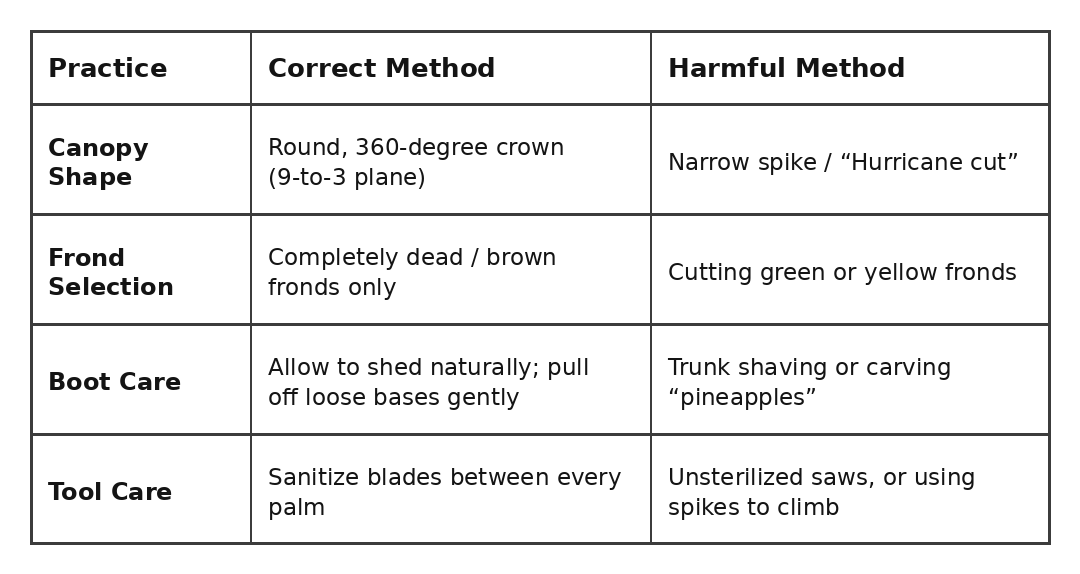
Arboricultural standards specify that living fronds above a horizontal line drawn across the canopy (from 9 o'clock to 3 o'clock) should never be cut.
- What to remove: Only fully brown, dead, or broken fronds, along with flower and fruit stalks.
- What to leave: All green fronds and yellowing fronds. Palms reabsorb mobile nutrients (like potassium and magnesium) from older, yellowing leaves to feed new growth.
Removing them induces nutrient deficiencies.
2. Avoid Severe Over-Pruning
- Say No to "Hurricane Cuts": Trimming palms into narrow upright spikes (often called "hurricane cuts" or "pencil-pointing") deprives the tree of food produced through photosynthesis. Contrary to popular belief, over-pruned palms are more susceptible to wind damage during storms because the crown lacks the natural wind-buffering resistance provided by a full canopy.
- Protect the Growing Bud: Cutting too close to the central heart can damage the single growing point, which can stunt growth or kill the palm entirely.
3. Equipment & Sanitation Standards
- Sanitize Tools: Fungal diseases like Fusarium wilt and Thielaviopsis trunk rot spread easily on contaminated tools. Disinfect handsaws or pole saws with a bleach solution or rubbing alcohol between every single palm tree.
- Never Use Climbing Spikes: Climbing gaffs or spikes puncture the fibrous trunk, leaving permanent wounds that open direct pathways for pests and fatal pathogens.
Qualified crews use aerial lifts, ladders, or static-line climbing setups instead.
What to Do with "Palm Boots"
Palm boots (or leaf sheaths) are the flared remnants left on the trunk after a frond dies or is trimmed away. Managing them correctly depends on species type, palm health, and landscape goals.
1. Natural Protection (Leave Them On)
In nature—and on species like the Sabal Palm (Sabal palmetto)—boots eventually loosen and fall off naturally as the palm matures. Arborists generally recommend leaving firmly attached boots alone:
- Sun & Moisture Shield: Boots insulate the underlying fibrous trunk from sunscald, excessive moisture loss, and mechanical damage.
- Wildlife Habitat: In native environments, boot structures provide nesting habitat for beneficial birds, bats, and pollinators.
2. Safe Boot Removal
If boots become loose, yellowed, or unsightly, they can be gently removed—provided proper care is taken:
- Remove Only Loose Boots: Gently pull on boots that have naturally detached from the trunk. If a boot offers strong resistance, leave it in place; forcing it off tears live trunk tissue.
- Avoid Shaving and "Pineapple Cuts": Shaving trunks or carving boots into decorative diamond shapes (popular on Canary Island Date Palms) creates massive open wounds across the trunk. These cuts invite destructive trunk rot organisms and insect infestations.
By adhering to ISA and TCIA guidelines, you ensure that palm trees stay structurally sound, visually appealing, and free from preventable diseases.