
Crape myrtles are the workhorse ornamental of Gulf Coast landscapes, offering a long bloom season, real heat tolerance, and beautiful exfoliating bark. Horticulturally they are considered essentially trouble-free small trees. But the warm, humid conditions that keep them blooming from June into fall also favor a short list of specific pests and fungal diseases. Nearly all of them are manageable if you identify the right problem and treat it in the right window.
Crape Myrtle Bark Scale
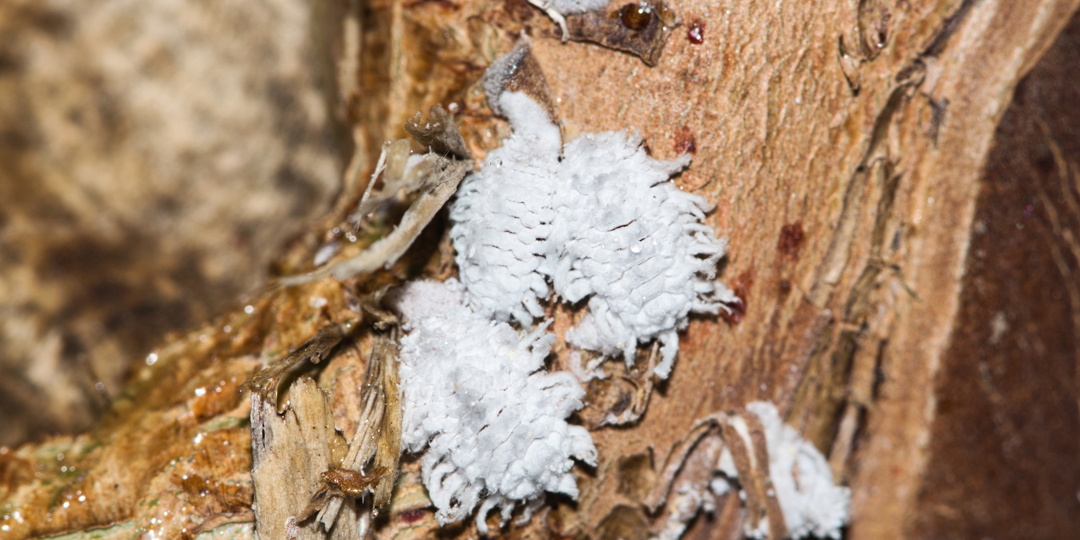
If the trunk and branches look dusted with white or gray felt-like bumps and the bark beneath is turning black, you are looking at crape myrtle bark scale. Crushing one of the bumps produces a pink ooze, which is a reliable field confirmation. The insects feed on sap, drain the tree's vigor, reduce bloom, and excrete honeydew that fuels black sooty mold across bark, leaves, and anything parked underneath.
Timing drives results here, and there are two proven chemical approaches:
Systemic soil drench, the preferred method. Apply imidacloprid or dinotefuran as a soil drench in a band along the dripline once the tree is leafing out and actively taking up nutrients. Texas A&M research points to mid-May as the optimal application date for best season-long prevention, while other Extension guidance targets late April to early May as trees begin to flush. A spring dinotefuran drench is the single most effective chemical control. Apply when the tree is not in bloom to protect pollinators.
Contact spray. Target the vulnerable immature crawler stage, which peaks mid-April through May, then repeat two weeks later. Bifenthrin performs best as an active ingredient, and adding horticultural oil improves crawler kill.
Two non-chemical steps meaningfully improve any treatment. Scrub the trunk and reachable branches with a soft-bristle brush and a dish soap solution to strip loose bark tissue, scale bodies, and sooty mold. Then, during dormancy when the tree has no leaves, apply a dormant oil containing paraffin oil, working it thoroughly under loose bark and into cracks and crevices where scale overwinter. This step can be repeated.
Aphids and Sooty Mold
The crape myrtle aphid is the most common insect pest on this species, and it feeds on nothing else. The insects are pale yellowish-green with black spots, roughly 1/16 to 1/8 inch long, and they mature in about ten days, meaning several generations stack up across a single Gulf Coast growing season.
Watch for yellow spotting on leaves caused by injected saliva, distorted new growth, and heavy honeydew coating the foliage. That honeydew is what produces sooty mold, and it also draws ants, wasps, and flies. Control options, roughly in order of escalation:
Let natural predators work. Ladybird beetles, green lacewings, hover fly maggots, and parasitic wasps all feed on crape myrtle aphids.
Knock populations down with a strong stream of water, repeated as needed.
Use horticultural oil as a contact killer once temperatures hold below 85 degrees for several days.
In the heat of the season, pair bifenthrin for quick knockdown with imidacloprid as a long-term systemic.
For a trunk-applied option, certain acephate products can be mixed into a slurry and painted directly onto the trunk.
A spring imidacloprid soil drench controls aphids and persists in the plant to prevent later infestations.
The sooty mold itself is unsightly but relatively harmless, since it does not attack plant tissue directly. Controlling the insects controls the mold. If you want it gone for appearance, drench the foliage with a dish soap solution at four ounces per gallon of water, wait three to four minutes, then rinse with a strong stream of water.
Powdery Mildew
Powdery mildew shows up as patches of white to grayish powdery growth on leaves, flowers, and new shoots. Heavily infected flower buds may never open, and affected growth becomes distorted and stunted. It is worst in shady, damp, crowded locations with poor air circulation, and it is driven by high nighttime humidity paired with mild, dry days, which is exactly our spring and fall pattern.
Cultural fixes carry most of the load. Site plants in full sun, keep them from being crowded, and remove basal sprouts as they appear, since suckers are highly susceptible and act as a launch point for the fungus to move into the upper canopy. Avoid over-fertilizing, and remove affected growth in fall. Systemic fungicides are generally not recommended for powdery mildew. When severity warrants chemical control, use a fungicide containing myclobutanil, propiconazole, thiophanate-methyl, or copper, and expect multiple applications.
Cercospora Leaf Spot
This is the disease that strips Gulf Coast crape myrtles bare in late summer. Look for yellow spots roughly 1/8 to 1/4 inch across on upper leaf surfaces, with white-gray fungal sporulation underneath. On susceptible cultivars it can cause almost complete defoliation in late summer and fall, and it thrives during warm, wet stretches.
The critical point is timing. Control requires a preventive fungicide application earlier in spring. A contact fungicide sprayed in late spring or early summer will kill the fungus, but the leaf damage is already done. Improve air circulation through appropriate spacing and selective pruning to reduce leaf wetness and humidity, and use thiophanate-methyl or myclobutanil when chemical control is justified.
Japanese Beetles and Lichens
Adult Japanese beetles are about half an inch long, coppery-brown with metallic green heads, and they feed from May through August, eating flowers and skeletonizing leaves down to a lacy network of veins. Handpicking works on light infestations. If you use traps, keep them at least 50 feet from the tree, or you will draw more beetles into the area than you remove. Milky spore targets grubs in the soil but has no effect on adults.
One thing that looks alarming but is not: lichens. These green to gray-green leafy or crusty growths on trunks and branches are a fungus and an alga living together, and they are completely harmless. They simply tend to be abundant on plants already declining in vigor, because thinner canopies let more sunlight reach the bark. Lichens are not the cause of poor health, and no control is needed.
Seasonal Treatment Calendar
Dormant season, no leaves: Apply dormant oil spray with paraffin oil, working it under loose bark and into crevices where scale overwinter.
Late winter to early spring: Apply preventive fungicide for Cercospora leaf spot before infection begins.
Mid-April through May: Use a contact spray at crawler peak, repeated 14 days later, if scale pressure is heavy.
Late April to mid-May: Apply a systemic soil drench of imidacloprid or dinotefuran at the dripline for bark scale and aphids.
After blooming ends: Apply a systemic insect spray, coating the trunk thoroughly, if pests persist.
Fall: Remove and dispose of mildew-affected growth and fallen leaves.
Any time, as needed: Scrub trunks with a soft brush and soapy water to remove scale and sooty mold.
Choosing Resistant Varieties
If you are planting new crape myrtles, cultivar selection eliminates most of these problems before they start. The hybrid crosses developed at the U.S. National Arboretum carry resistance to powdery mildew. Arapaho is one cultivar noted for excellent powdery mildew resistance along with improved cold hardiness, and heat-bred selections generally hold up better against fungal issues in Texas summers than older common crape myrtles.
Pair a resistant cultivar with a full-sun planting site and adequate spacing, and you remove the two biggest drivers of disease pressure at the same time. That single decision at planting saves years of spray schedules.
Protect Your Crape Myrtles This Season
Crape myrtle problems are seasonal, which means the window to prevent them is narrow. A treatment applied in May does work that no amount of effort in August can replicate. Monster Tree Service of Texas Gulf Coast provides shrub and ornamental health care, including targeted treatments for crape myrtle bark scale and regional aphid outbreaks, for properties in Webster, Deer Park, Seabrook, La Porte, League City, Kemah, Pasadena, Baytown, and surrounding Gulf Coast communities. Contact us to schedule an evaluation and get your trees on a proactive treatment schedule.