
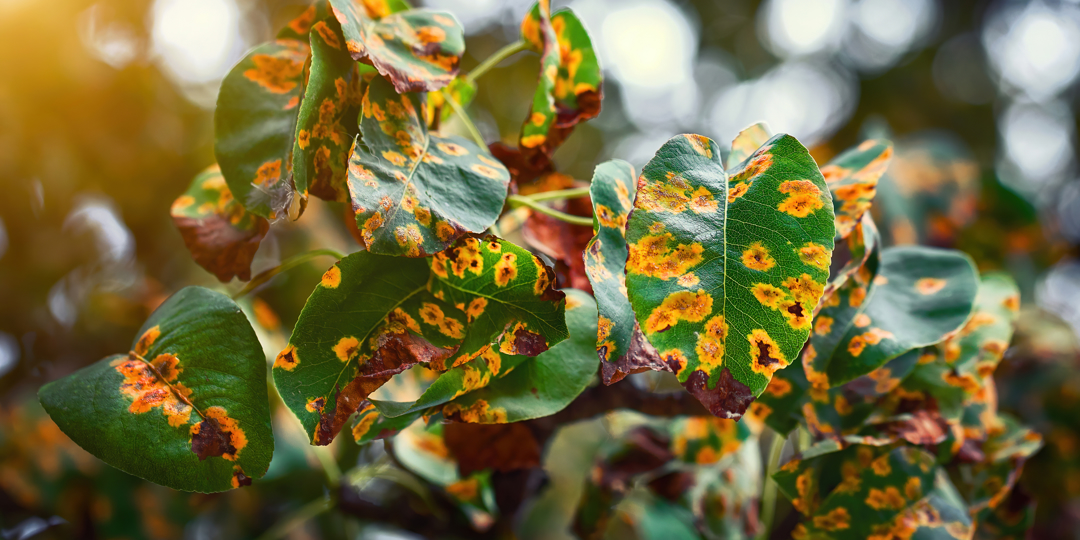
Along the Texas Gulf Coast, trees fight a year-round battle. Heavy clay soils, high humidity, salt air off Galveston Bay, and 100-degree summers all weaken a tree's natural defenses, and weakened trees are exactly what fungal pathogens look for. The good news is that most tree diseases announce themselves long before a tree becomes a hazard. Knowing what to look for is the difference between a treatable problem and an emergency removal.
Start With the Leaves
Foliage is usually the first place trouble shows up. Watch for premature leaf drop, reduced foliage density, or leaves that come in noticeably smaller than in past seasons. Dark spots, unusual yellowing, browning along leaf margins, or distorted leaf shapes all warrant a closer look. Repeating leaf discoloration season after season, not just during one hot August, is a strong early indicator that something systemic is happening, and it is how several of the most common tree diseases in Texas first announce themselves.
On live oaks, one leaf pattern matters more than any other. Oak wilt produces veinal necrosis: leaf veins turn yellow, then brown, creating a pattern many homeowners describe as looking like fish bones, and the leaf drops soon after. Red oaks decline fastest, often within four to six weeks of showing symptoms, which leaves almost no window for therapeutic treatment.
Check the Trunk and Base
Bark and root flare tell you about structural decay. Mushrooms clustered near the roots, shelf-like conks pushing out of the bark, soft or spongy wood at the base, and hollow-sounding wood when tapped are all signs of internal rot that a professional tree inspection can confirm. In our region, Ganoderma root rot is a frequent culprit. Its most telling sign is a rust-colored, shelf-shaped fruiting body low on the trunk or emerging from the soil at the base, paired with yellowing leaves, canopy dieback, and slowed growth.
Hypoxylon canker is the other trunk disease Gulf Coast property owners should know. It attacks trees already stressed by drought, construction damage, or root injury, and it produces a thinning canopy, dead limbs, small leaves, water sprouts on the trunk and large limbs, and sapwood that turns white and stringy in the cankered area. As it advances, bark sloughs off to reveal a hard, tan-to-brown fungal mat.
Watch the Canopy and Branches
Symptoms that appear in one section of the crown rather than uniformly across the tree usually point to disease or a root problem rather than simple heat stress. Flag these for a professional inspection:
Dead branches or branch tips carrying no foliage
Sudden branch drop during calm, windless weather
Wilting or drooping limbs isolated to one side or section
Water sprouts erupting along the trunk and major limbs
Stunted or unusual new growth compared to previous years
A thinning crown you can increasingly see sky through
Why Gulf Coast Conditions Accelerate Disease
Two regional factors make early detection more urgent here than in other parts of Texas. First, our compacted clay soils hold water and starve roots of oxygen, which sets up the chronic stress that opportunistic pathogens like Hypoxylon canker require to take hold. Second, our long, humid growing season gives fungal spores far more infection windows than a drier climate allows.
Add hurricane season to that picture and the stakes change. A tree with advanced internal decay may look acceptable in July and come down on a roof in September. Structural decay does not announce itself through the canopy until it is already extensive, which is why visual inspection of the trunk and root flare belongs in your routine, not just your storm prep.
Treatment Options by Diagnosis
Treatment depends entirely on correct identification, which is why a certified arborist inspection comes before any product application. Broadly, options fall into these categories:
Cultural correction, the foundation for stress-driven diseases like Hypoxylon canker: deep root fertilization, soil decompaction, proper mulching away from the root collar, and consistent irrigation during drought to restore vigor.
Fungicide injection, used for oak wilt, where injections protect individual high-value trees but do not stop spread across a property.
Root trenching for oak wilt moving through interconnected root systems. Trenches are cut at least 100 feet outside the dripline of infected trees and at least four feet deep to sever root grafts.
Targeted pruning and sanitation: removing infected limbs, sterilizing tools between cuts, and avoiding pruning during high-risk transmission windows.
Removal, when decay has compromised structural integrity. There is no cure for oak wilt, and advanced root rot creates unacceptable fall risk.
Early detection genuinely changes outcomes. Success rates are dramatically higher when problems are caught at the leaf-symptom stage rather than after conks, large cavities, or a sudden lean appear.
Get a Professional Diagnosis
If you have noticed any of these signs on your property in Deer Park, La Porte, Seabrook, League City, Baytown, Pasadena, or anywhere along the Texas Gulf Coast, do not wait for storm season to find out how compromised the tree is. Monster Tree Service of Texas Gulf Coast provides tree health evaluations and hazard tree inspections performed by trained professionals who know regional pathogens. Schedule your inspection today.