
Key Takeaways:
Houston summers force trees to lose moisture faster than roots can replace it, and compacted Gulf Coast clay makes the deficit worse.
Deep watering at the dripline, a properly placed mulch ring, and a protected root zone cover most of what a tree needs to survive the season.
Heat stress invites borers, scale, and disease, so pairing moisture recovery with targeted pest management keeps small problems from compounding.
Houston summers punish trees in ways that are easy to miss until damage is done. Weeks of 95 to 100 degree afternoons, high humidity, and long stretches without meaningful rain force a tree to lose more moisture through its leaves than its roots can pull from the soil. Trees have no internal water reserve, so that deficit shows up fast. Heat stress is the opening act for pests, pathogens, and the kind of structural decline that turns into an emergency once hurricane season arrives.
How Heat Stress Actually Works
Trees cool themselves through transpiration, releasing water through their leaves the same way sweating cools a person. Water moves from the soil, up through the trunk, and out into the air continuously. When soil moisture drops and air temperatures climb, the tree closes its leaf pores to conserve water, photosynthesis slows, and the tree starts running on stored energy it should be saving for next spring.
Our regional soils make that math worse. Heavy Gulf Coast clay holds water well once it absorbs it, but it takes water in slowly and it compacts under foot traffic, vehicles, and construction. Roots sitting in compacted clay have limited access to both oxygen and moisture, so a tree in a well-watered yard can still be running a moisture deficit.
Signs of Heat Stress to Watch For
Symptoms usually appear in the canopy before anything shows on the trunk. Walk your property in the morning, when leaves are least likely to be wilting from midday heat alone, and look for these signals:
Leaves curling, cupping, or wilting and not recovering overnight
Browning or scorched edges along leaf margins, often called leaf scorch
Premature leaf drop in July and August rather than fall
Leaves smaller than the tree produced in previous seasons
Dieback at branch tips and slowed shoot growth
Cracked or splitting bark on thin-barked species
A visible increase in insect activity on trunks or foliage
One caution on interpretation. Symptoms spread evenly across the whole canopy usually point to water and heat. Symptoms concentrated in one section of the crown more often point to a root problem or a disease, and those are worth a professional tree inspection rather than more water. Several of the common tree diseases in Texas look like heat damage in their early stages.
Water Deep, Not Often
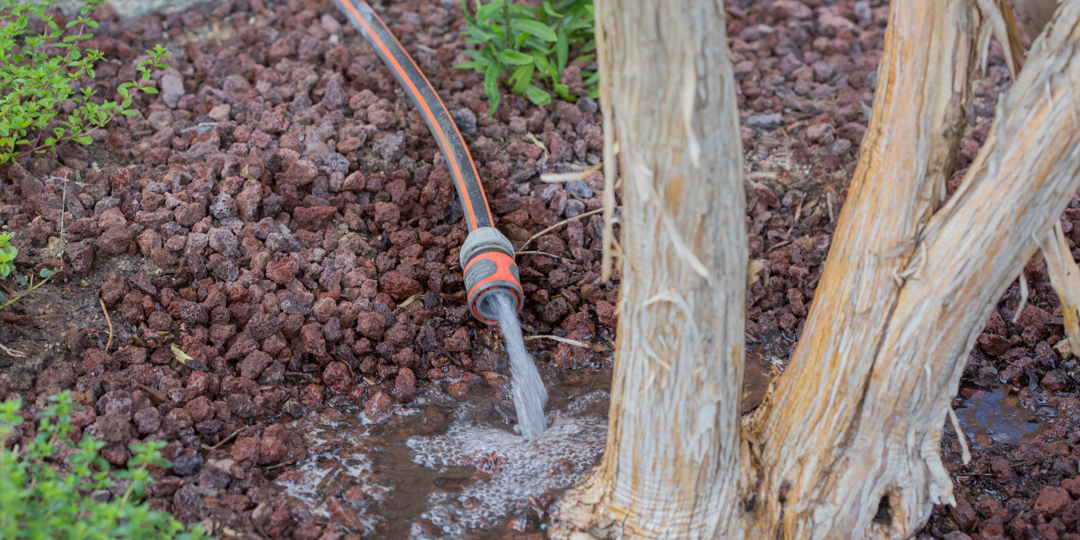
The single most useful summer habit is watering slowly and deeply at the dripline instead of lightly and frequently near the trunk. Shallow watering trains roots to stay near the surface, which is the hottest and driest layer of soil in a Houston August.
A soaker hose laid in a ring under the canopy works well in clay, because it releases water slowly enough that the soil can absorb it instead of shedding it. Run it long enough to wet the top six to twelve inches of soil, then let the surface dry before the next cycle. Texas A&M Forest Service guidance for young trees in a typical summer is two to three gallons per inch of trunk diameter, two to three times per week, with the caution that soil should never sit saturated.
Timing matters as much as volume. Water early in the morning or in the evening to limit evaporation loss, and keep water off the foliage, since wet leaves in Gulf Coast humidity invite fungal leaf spot. Newly planted trees and trees installed in the last three years need the most attention, because their root systems have not spread far enough to find moisture on their own. Established trees showing no stress signals often need no supplemental water at all.
Mulch Is the Cheapest Protection You Can Buy
A two to three inch layer of organic mulch spread under the canopy moderates soil temperature, slows evaporation, buffers the drying effect of wind, and suppresses turf competing for the same water. Extend the ring as wide as practical, ideally out toward the dripline rather than a narrow circle at the base.
Keep mulch pulled back several inches from the trunk. Mulch piled against bark traps moisture at the root collar and invites rot and pests, which undoes the benefit. If mulch or soil has already buried the root flare, root collar excavation uncovers it and restores air movement where the trunk meets the ground.
Hold Off on Heavy Pruning
Summer is the wrong season for major canopy work in Houston. Pruning live tissue forces a tree to spend stored energy sealing wounds, energy an already stressed tree needs for survival. Heavy thinning also exposes interior branches and bark that have never seen direct sun, which leads to bark scorch and sunscald.
The exception is safety. Dead, broken, cracked, or hanging limbs should come out whenever you find them, and deadwooding carries no cost to the tree's energy budget. Save structural pruning and trimming for the dormant season, before storm season rather than during the worst of the heat.
Protect the Root Zone
Roots do most of their work in the top foot of soil, spreading well beyond the dripline. Anything that compacts that zone reduces water and oxygen uptake exactly when the tree can least afford it. Keep vehicles, trailers, and equipment off the root zone, route foot traffic around it, and avoid trenching or grade changes near mature trees during summer.
If your soil is already compacted, soil health care treatments relieve compaction and improve infiltration in clay. Where nutrient deficiency is part of the picture, deep root fertilization delivers what the tree needs below the turf layer rather than feeding the lawn. Broadcast chemical fertilizer in peak heat pushes growth the tree cannot support and increases its water demand, so let soil and tissue testing drive that decision instead of a guess.
Heat Stress Invites Pests
Stressed trees give off chemical signals that opportunistic insects detect. Borers, scale, and spider mites all concentrate on trees that are already struggling, and piercing insects pull fluid from a tree that has none to spare. Pines under drought pressure become candidates for bark beetle activity, which moves quickly once it starts.
Treating the insects alone rarely solves the problem, because the heat and moisture deficit are the root cause. A combined approach works better: restore soil moisture, relieve compaction, and pair that with targeted insect and disease management when an active infestation is confirmed.
Species Notes for the Gulf Coast
Live oaks handle our summers comparatively well once established, though they still decline under sustained drought paired with compacted soil. Loblolly and other pines show stress through thinning, fading needles and are the species most likely to attract beetles afterward. Crape myrtles tolerate heat but respond to drought stress with reduced bloom and heavier pest pressure.
Young trees of any species, including recent new plantings, carry the highest risk, since their roots have not reached deeper soil moisture. If you are choosing replacements, heat-adapted species for Southeast Texas reduce this problem permanently. Shrubs deserve the same attention, and shrub care basics follow much of the same logic.
Give Your Trees a Plan Before the Next Heat Wave
Summer damage compounds. A tree that limps through August with a depleted energy reserve is the same tree that fails in a September wind event or shows disease symptoms next spring. Consistent deep watering, a proper mulch ring, an untouched root zone, and restraint on pruning cover most of what a Houston tree needs to get through the season intact.
Monster Tree Service of Texas Gulf Coast provides tree and shrub health care, soil treatments, and hazard evaluations for properties in Webster, Deer Park, Seabrook, La Porte, League City, Kemah, Pasadena, Baytown, and surrounding Gulf Coast communities.