
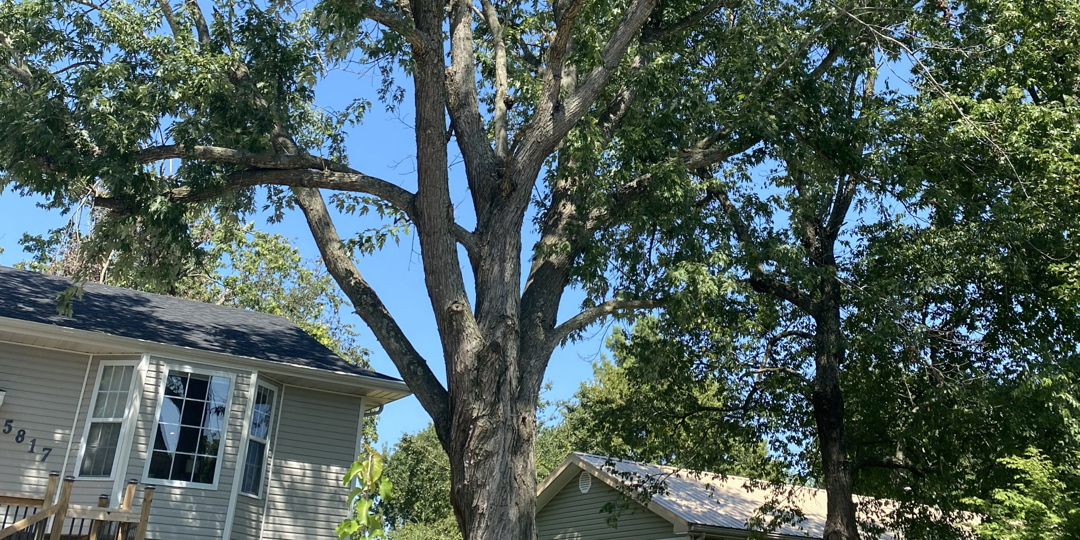
Yes, Many Storm-Damaged Trees Can Be Saved. One of the biggest misconceptions homeowners have is that every storm-damaged tree needs to be removed. That's simply not true.
Trees have evolved to survive high winds, heavy rain, ice storms, and lightning. Throughout Missouri, mature oaks, maples, hickories, and sycamores have endured hundreds of storms during their lifetime.
The key question isn't whether the tree lost branches.
The real question is whether the tree still has enough structural integrity to remain safe.
Research from university forestry experts consistently shows that trees with limited damage, especially those losing less than roughly half of their canopy, often recover successfully with proper pruning and aftercare. On the other hand, trees with split trunks, extensive bark loss exposing the cambium, or severe structural damage are much less likely to recover safely.
The First Thing an Arborist Looks At
When I inspect a storm-damaged tree, I don't start with the broken branches.
I start with the trunk.
The trunk tells the story of whether the tree can safely support itself in the future.
A large branch lying in the yard may look dramatic, but if the trunk remains solid and the branch attachment fails cleanly, the tree often has an excellent chance of recovery.
A tree with a split trunk, however, is an entirely different situation.
Once the main stem has fractured or split deeply, the tree loses much of its structural strength. Even if it survives biologically, it may never again be safe enough to stand near a home, driveway, or sidewalk.
That's why experienced arborists evaluate structure before appearance.
Broken Branches Don't Always Mean the Tree Is Lost
Many healthy trees lose limbs during severe storms.
This is especially common after straight-line winds or heavy, wet snow.
If only a few large limbs have broken and the remaining canopy is balanced, proper structural pruning can often restore the tree.
Professional pruning removes torn wood, creates clean cuts that heal more efficiently, and reduces the likelihood of decay entering the damaged area.
One mistake I frequently see homeowners make is cutting branches flush against the trunk or leaving long stubs behind. Both practices slow healing and create ideal entry points for insects and decay fungi.
Corrective pruning should always follow accepted arboricultural standards rather than simply removing whatever looks broken. Professional guidance commonly recommends pruning to ANSI A300 standards after storm damage.
Root Damage Is Often More Serious Than Branch Damage
Some of the most dangerous storm damage happens underground. High winds don't always snap trees. Sometimes they partially lift the root system before the tree settles back into place. To an untrained eye, the tree may appear perfectly upright.
An arborist, however, may notice cracked soil, lifted roots, or subtle movement around the base of the trunk. These are warning signs that the tree's anchoring system has been compromised.
A partially uprooted tree may survive for months or even years before failing during the next storm.
That's why the root flare deserves just as much attention as the canopy.
Trees Can Hide Internal Damage
One reason homeowners should avoid making immediate decisions after a storm is that trees often hide serious injuries.
Fresh leaves can remain green even after major structural failure.
Internal cracks may not become visible until weeks later.
Decay fungi may begin colonizing damaged wood long before there are obvious external symptoms.
For this reason, I rarely recommend rushing into removal unless the tree presents an immediate safety hazard.
Instead, a thorough inspection allows hidden defects to be identified before deciding whether preservation is realistic.
When a Storm-Damaged Tree Can Usually Be Saved
Healthy trees have an incredible ability to compartmentalize wounds and produce new growth.
If the trunk remains intact, the root system is stable, and only a portion of the canopy has been damaged, recovery is often possible.
I've seen mature oaks throughout Springfield lose major limbs during spring storms and continue growing for another thirty or forty years after receiving proper structural pruning.
Young trees are even more resilient. Because they grow rapidly, they often replace damaged branches surprisingly quickly when their central structure remains intact.
The sooner corrective care begins, the better the long-term outcome.
When Removal Becomes the Safest Option
While arborists always prefer preserving trees whenever possible, there are situations where removal is the responsible recommendation.
A tree that has split down the middle, lost most of its canopy, suffered severe root failure, or developed extensive structural instability may no longer be safe.
Likewise, if a damaged tree threatens a home, power line, driveway, or public roadway, the risk often outweighs the benefits of preservation.
Storm damage can also expose hidden decay that existed long before the storm arrived.
In many cases, the wind simply reveals weaknesses that have been developing for years.
Removing a hazardous tree before it fails unexpectedly protects both people and property.
What You Should Do Immediately After a Storm
The first priority is always safety.
Stay away from hanging limbs, leaning trees, and anything touching utility lines. Never attempt to climb a damaged tree or remove large branches under tension. Storm-damaged wood behaves unpredictably and can fail without warning.
Once the area is safe, document the damage with photographs before any cleanup begins. These photos may be useful for insurance claims and help an arborist evaluate the tree's condition.
Avoid the temptation to "clean up" by cutting random branches. Well-intentioned pruning often removes healthy wood that the tree needs for recovery.
Instead, have the tree inspected before making permanent decisions.
Can a Storm-Damaged Tree Become Healthy Again?
In many cases, yes.
Trees don't heal the way people do.
Instead, they seal damaged tissue through a natural process called compartmentalization. New wood gradually forms around wounds while healthy tissue isolates damaged areas.
Depending on the species, the extent of the injury, and the tree's overall health before the storm, recovery can take several years.
Proper watering during dry periods, mulching around the root zone, avoiding soil compaction, and corrective pruning all improve the tree's chances of long-term success.
Patience is often the most important part of the recovery process.
Trust Monster Tree Service of Springfield and Branson
After a major storm, every damaged tree deserves a professional evaluation before removal is considered.
At Monster Tree Service of Springfield and Branson, our experienced arborists carefully inspect storm-damaged trees to determine whether they can be safely preserved or whether removal is the best long-term solution. We evaluate structural integrity, root stability, canopy damage, and overall tree health before making recommendations, because every tree is different.
Whether your property has suffered broken limbs, wind damage, lightning strikes, or uprooted trees, our team provides honest, expert guidance to help you make the safest decision for your landscape.
Frequently Asked Questions
Can a tree survive after losing a large branch?
Yes. If the trunk and root system remain healthy, many trees recover well after losing one or even several major limbs. A certified arborist should evaluate the remaining structure before deciding on removal.
How long does it take a storm-damaged tree to recover?
Recovery depends on the tree species, age, overall health, and severity of the damage. Some trees begin producing new growth within the next growing season, while complete recovery may take several years.
Should I cut broken branches myself?
Small branches that can be reached safely may be removed with proper pruning techniques. However, large broken limbs, hanging branches, leaning trees, or trees near structures should always be handled by a qualified arborist for safety reasons.
Can a leaning tree be saved?
Sometimes. A slight lean doesn't automatically mean the tree is unsafe, but a newly developed lean after a storm, especially if accompanied by lifted soil or exposed roots, should be inspected immediately because it may indicate root failure.