
Key Takeaways:
Palms grow from a single bud at the top of the trunk, so overwatering, over-pruning, and damage to that bud hurt them far more than they would hurt an oak.
Potassium deficiency is the most common nutritional disorder of palms, according to UF/IFAS, and it shows up first on the oldest fronds.
As of October 2026, the Texas Department of Agriculture lists infested portions of Galveston County, including Kemah, under an active lethal bronzing quarantine, and the disease has no cure.
Palms give a bay-front yard its look. They also get treated like ordinary trees, and that is where most of the trouble starts.
Gulf Coast palms deal with heavy clay, salt air, hurricane season, the occasional hard freeze, and now a fatal disease moving through Galveston County. Good palm care on this coast comes down to a short list of habits, and most of them involve doing less, not more.
Why Don't Palms Respond Like Other Trees?
Palms aren't trees in the botanical sense. They are monocots, closer kin to grasses than to the live oak in your backyard. Cut one down and you won't find growth rings in the trunk.
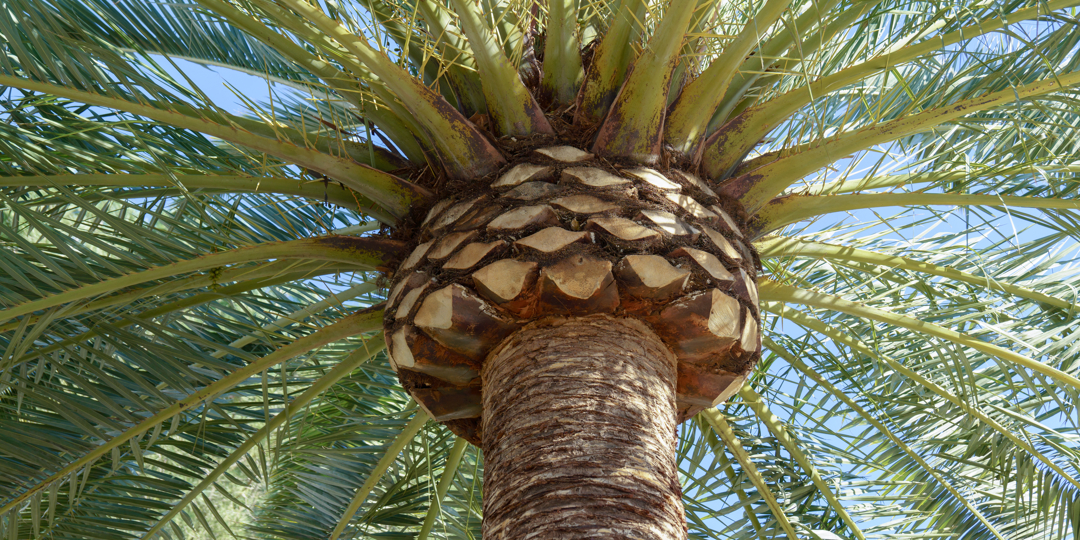
The detail that matters most for care is the growing point. A palm makes all of its new growth from one bud at the top of the trunk, and the spear leaf you see emerging from the center is its newest frond.
Damage that bud and the palm can't branch around the injury the way an oak would. It declines. Nearly every rule below comes back to protecting that bud and the green fronds that feed it.
Which Palms Are Growing on Your Property?
Care starts with knowing what you have, since species handle cold, nutrients, and disease differently. Most Bay Area landscapes include some mix of these:
Sabal palms, including the Texas sabal (Sabal mexicana) and the cabbage palm (Sabal palmetto)
Mexican fan palms (Washingtonia robusta), the tall, skinny palms that line older streets
Queen palms (Syagrus romanzoffiana), with feathery, arching fronds
Canary Island date palms (Phoenix canariensis), heavy-trunked and slow-growing
Pygmy date palms (Phoenix roebelenii), common in beds and near entries
Texas Master Gardeners point out that the Texas sabal and the dwarf palmetto are the only two palms native to the state. The same article notes sabals came through recent Coastal Bend freezes unbothered, which is worth weighing before you plant anything new.
How Much Water Do Palms Need on Gulf Coast Clay?
Less than most people give them. Our clay holds water for a long time once it soaks in, and a palm sitting in soggy soil is set up for root and trunk rot.
Newly planted palms do need steady moisture as their roots establish. Established palms in clay usually do fine on rainfall plus occasional deep watering during dry stretches. If water pools around the base after a storm, fix the drainage before you add anything else. A palm irrigation inspection catches overspray and poor drainage before they turn into rot.
What Should You Feed a Palm?
Palms need many of the same nutrients as broadleaf trees, just in different proportions. Lawn fertilizer is the wrong tool. UF/IFAS identifies potassium deficiency as the most common nutritional disorder of palms, and notes that high-nitrogen fertilizer and over-pruning can both make it worse.
Learn to read the fronds. Here are the patterns UF/IFAS describes:
Potassium: yellow or translucent spotting and brown tips, starting on the oldest fronds
Magnesium: bright yellow bands along the edges of older fronds, a chronic issue for Canary Island date palms
Manganese: stunted, frizzled new growth at the top of the palm
A slow-release, palm-specific fertilizer is the usual fix, and a tailored fertilization program built around your species and soil keeps you from guessing. If you can't tell which nutrient is short, soil and tissue testing gives you an answer before you spend money on the wrong product.
How Much Should You Prune a Palm?
Far less than you've probably seen around town. The "hurricane cut," where a palm gets stripped to a few upright fronds, looks tidy for a week and costs the palm months. Green fronds store potassium and feed the bud. Cut them off and the palm loses both.
Texas Master Gardeners put it plainly: palms rarely need pruning, and over-pruning affects their nutrient levels. Here is what a palm actually needs removed:
Dead, brown fronds that hang below horizontal
Old fruit and flower stalks
Loose material on the trunk, removed carefully through palm skinning
Leave yellowing fronds alone when you can, since the palm is still pulling nutrients out of them.
Climbing spikes have no place in palm work either, since every puncture is a permanent wound in a trunk that can't heal over. Our crews climb palms without spikes. For larger palms or mixed properties, our pruning and trimming work follows the same rule: take only what is dead or hazardous.
What Is Lethal Bronzing, and Why Should Gulf Coast Owners Care?
Lethal bronzing is the palm disease worth watching on this coast. Texas A&M AgriLife Extension describes it as the only known phytoplasma disease of palms in Texas, able to kill a palm within a year, and a reportable, regulated condition. The Texas Department of Agriculture says there is currently no cure. Leafhoppers, planthoppers, and palm cixiids spread it as they feed.
As of October 2026, the Texas Department of Agriculture lists infested portions of Galveston County under an active lethal bronzing quarantine, including Kemah and Jamaica Beach on Galveston Island. An earlier Harris County quarantine expired in May 2026. The TDA list of affected species reads like a Bay Area plant inventory: Texas sabal, cabbage palm, queen palm, Mexican fan palm, Canary Island date palm, pygmy date palm, Chinese fan palm, and windmill palm, among others.
Watch for these symptoms, which TDA lists:
Immature fruit dropping from the palm
The oldest fronds turning brown or yellow, starting at the tips
Dying roots (root necrosis), which you won't see without digging
Those signs overlap with potassium deficiency, so don't diagnose by eye alone. If you suspect lethal bronzing, report it to the nearest TDA regional office or your county AgriLife office, and don't move palms or palm material out of a quarantine area. Our insect and disease management team can evaluate a declining palm and help you decide on next steps. A palm confirmed with the disease usually has to come out, and our guide to what palm removal costs on the Gulf Coast walks through that process.
What Should You Do After a Freeze or a Storm?
Be patient after a freeze. Brown, cold-damaged fronds look awful, but cutting them right away removes protection and tells you nothing.
Wait until warm weather returns and watch the spear leaf. A firm spear and new green growth mean the bud survived. A spear that pulls out easily or smells rotten means the bud was damaged, and the palm needs a closer look.
Storms bring a different set of problems. Hanging fronds, cracked trunks, and palms leaning after saturated soil all deserve a professional tree inspection before anyone gets under them. Hurricane season runs through November, and the steps in our hurricane season prep guide cover palms along with the rest of your canopy. Resist the urge to strip palms bare before a storm.
Keep Your Gulf Coast Palms Healthy Year-Round
Palms reward a light touch. Water them less than the lawn, feed them for potassium, prune only what's dead, and keep a close eye on the oldest fronds.
Lethal bronzing raises the stakes for every palm owner in Galveston County. Catching problems early gives you options.
Monster Tree Service of Texas Gulf Coast cares for palms across Kemah, Clear Lake, Seabrook, League City, La Porte, Webster, and surrounding Gulf Coast communities. Call or text our team for a free estimate, with no obligation.