
Key Takeaways:
Drought damage builds over months and often surfaces a season or two later, so recovery work matters as much as survival watering.
Water the highest-priority trees first with slow, deep soaks at the dripline, and fix compacted clay soil instead of relying on turf sprinklers.
Stressed trees attract beetles and borers and can hide structural decay, so pair watering with pest management and a pre-storm-season inspection.
Drought along the Texas Gulf Coast rarely arrives as a single dramatic event. It builds through a dry spring, a rainless July, and a September that never delivers, and the trees on your property spend that whole stretch drawing down reserves they cannot replace. The harmful effects of drought on trees often surface a season or two after the dry weather ends, which is why recovery work matters as much as survival watering.
Drought recovery is possible for many trees. It depends on how far decline has progressed, the species, and whether the underlying soil problem gets corrected rather than papered over with a sprinkler.
Read the Symptoms Before You Act
Start by confirming that drought is actually the problem. Drought-stressed trees typically show leaves curling, wilting, and drying out, yellowing foliage or needles, stunted growth, and early leaf drop across the entire canopy. Symptoms in one section of the crown point somewhere else, usually roots or disease.
Some deciduous trees respond to drought by going dormant early, dropping leaves in August as a defensive move. It looks like the tree is dying, and it is not, but premature dormancy is still costly. A tree with no leaves cannot photosynthesize, so it stops making food months earlier than it should and enters winter with a thinner reserve.
Conifers do not have that option. A pine cannot regenerate a full flush of needles the way a live oak regrows leaves, so pines and other conifers that lose a large share of their foliage often cannot be brought back.
Triage: Decide Which Trees Get Water First
Under water restrictions or limited time, spreading water evenly across every tree helps none of them. Texas A&M Forest Service guidance is to prioritize deliberately.
Young trees planted within the last three years come first, since their root systems are too small to reach deeper soil moisture.
Large shade trees near the house come next, because their cooling value and replacement cost are highest.
Trees with real meaning to you, for shade, screening, or history on the property, belong on the list.
Established, healthy trees with no stress symptoms can usually be left alone.
The goal during severe drought shifts. You are keeping a tree alive until conditions change, not pushing it to grow. Under extreme drought conditions, trees can survive on roughly half of typical recommendations, around one to two gallons per inch of trunk diameter once a week.
Water Slowly, Deeply, and at the Dripline
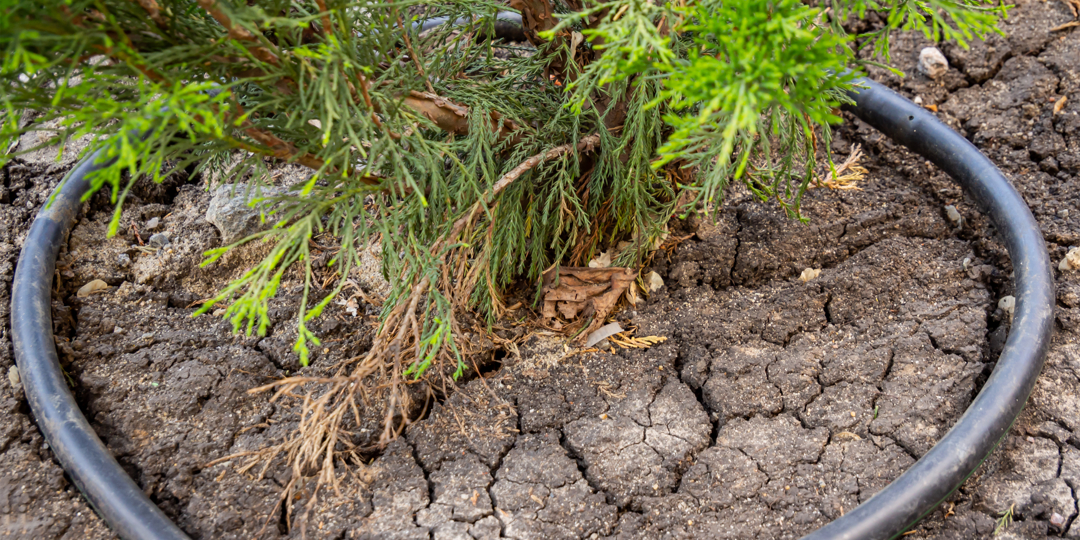
Clay soil rewards patience. It absorbs water slowly and holds it well once saturated, so a fast, heavy application mostly runs off. A soaker hose arranged in a ring under the canopy, run for two to four hours once or twice a week, delivers moisture at a rate the soil can actually take.
A few practices carry most of the benefit:
Water at and slightly beyond the dripline, not against the trunk, since absorbing roots sit out under the canopy edge.
Water in the early morning or evening to cut evaporation loss.
Keep water off foliage, because wet leaves in Gulf Coast humidity encourage fungal problems.
Skip the practice of digging holes to water deeper, which dries out the surrounding root zone.
Check irrigation lines for leaks so the water you are paying for reaches the tree.
Sprinklers designed for turf are a poor tool here. They wet the top inch of soil, favor grass roots that compete with the tree, and lose a large share to evaporation before it ever soaks in.
Fix the Soil, Not Just the Moisture
Drought damage in our region is usually a soil story. Compacted clay restricts oxygen and slows water infiltration, so roots in that soil are stressed even in a normal rainfall year. Recovery work should address that directly through soil health care treatments that relieve compaction and improve structure.
A two to three inch mulch layer under the canopy does more for a recovering tree than most other interventions, holding soil moisture and moderating root zone temperature. Keep it off the trunk. If soil or old mulch has buried the root flare, root collar excavation exposes it again.
Go easy on fertilizer during active drought. Chemical fertilizer pushes new growth and increases water demand at the worst possible moment. Once rainfall returns and the tree begins recovering, deep root fertilization guided by soil and tissue testing restores nutrients where the roots can use them. Compost worked into the surface is a safer choice during the dry stretch itself.
Expect Insects to Show Up Second
Drought-stressed trees emit chemical signals that opportunistic insects locate easily. Piercing and sucking insects draw fluid from a tree that has none to spare, and wood boring larvae tunnel through trunks and branches, causing damage that no amount of water reverses. Pines under sustained drought are the classic Gulf Coast example, with beetle activity following months after the dry weather.
Watering alone will not clear an active infestation. When insects have taken hold, restoring soil moisture and applying targeted insect and disease management at the same time gives the tree a real chance. The same logic applies to fungal problems: many pathogens that appear during drought recovery are secondary, and the warning signs of tree disease are worth learning so you can tell the difference between a symptom and a cause.
Watch for Structural Risk During Recovery
Drought does quiet damage to wood. Trees that have cycled through repeated dry summers develop dieback, internal decay, and root loss that a full canopy can hide. That combination is what produces sudden limb drop on a calm afternoon, and it is what turns an ordinary tropical system into property damage.
A tree inspection that includes the trunk and root flare is the right step before storm season. Dead and hanging limbs should come out through deadwooding, which costs the tree no stored energy, and heavier structural work belongs in the dormant season. Building that into your hurricane season preparation routine keeps two problems from stacking on top of each other.
When Drought Recovery Is Not Realistic
Some trees pass the point of return. Advanced decay, a large share of dead canopy, a lean that has developed recently, or a pine or other conifer that has shed most of its needles all point toward removal rather than treatment. Deciding early is safer and usually cheaper than waiting for the tree to decide during a wind event, and tree removal done on your schedule beats emergency work done on the storm's schedule.
Replanting afterward is the chance to fix the underlying vulnerability. Choosing heat-adapted species for Southeast Texas and following sound tree planting practices for Houston properties means the next drought asks less of you.
Start Drought Recovery Before the Next Dry Season
Trees recover from drought on a multi-year timeline, not a two-week one. Consistent deep watering, a wide mulch ring, corrected soil, and honest assessment of which trees can be saved will carry most Gulf Coast landscapes through. The trees that fail are usually the ones nobody looked at closely until the canopy thinned.
Monster Tree Service of Texas Gulf Coast provides tree and shrub health care, soil and root zone treatments, and hazard evaluations for properties in Webster, Deer Park, Seabrook, La Porte, League City, Kemah, Pasadena, Baytown, and surrounding Gulf Coast communities.