
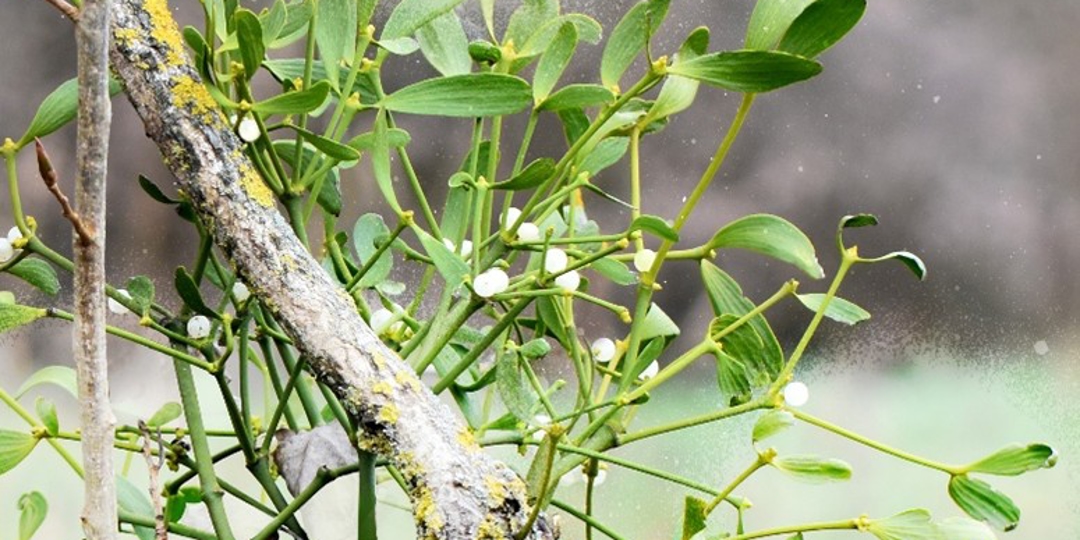
Mistletoe has long been a favorite plant used as decoration for winter holiday traditions throughout much of Europe and the United States. While it may be a charming symbol of the holiday season, mistletoe is a parasitic plant that can pose a threat to trees. In this article we will take a closer look at this enigmatic plant to give you some insight into managing mistletoe, as well as give you some perspective about what it may be saying about the health of your trees.
What is mistletoe?
Mistletoe is an evergreen plant that usually appears on the branches of trees as 1-2 foot diameter green clusters. It tends to be seen more in the winter after trees have lost their leaves. Mistletoe is most commonly associated with oak trees, but may also be found in pecan, hackberry, elm, cherry and sycamore trees. About 30 species are known to grow in the United States. 1
Mistletoe is partially parasitic and relies on a host for its water and nutrients, but not its energy resources. Being green, mistletoe still contains chlorophyll and carries out photosynthesis to make its own sugars. 2 One of the most well known species is American mistletoe (Phoradendron serotinum) that ranges throughout the southeastern United States and northward from New York to Ohio. 3 Interestingly, the scientific name Phoradendron translates as “thief of the tree,” 4 referring to its parasitic nature.
Mistletoe’s thick oval green leaves and white winter berries make it a popular holiday decoration. The berries are also a favorite food of many birds which play a major role in dispersing the seeds within to other trees. These seeds have a sticky coating which helps them anchor into the bark of its host tree, where they germinate and grow. 5
Is mistletoe really a threat or just a messenger telling you that something may be wrong?
Commonly, mistletoe is blamed for poor tree health, but it generally attacks trees that already are in poor health and decline. It can especially hurt trees that are stressed by drought and poor soil conditions. Declining trees with sparse foliage in the spring and summer also allow mistletoe more access to space and sunlight which gives the plant greater opportunity to grow. 6
In contrast, a healthy tree with dense foliage usually can shade out any mistletoe that tries to become established. Additionally, a faster-growing, more vigorous tree sheds its older bark at a faster rate which gives the tree an extra advantage, allowing it to shed off the sticky mistletoe seeds before they can sprout. 7
Managing mistletoe
Managing mistletoe can be difficult for a number of reasons. 8
- Selective controls are not available, and an herbicidal product applied to target mistletoe would likely harm the tree.
- Pruning out affected branches may also make the problem worse by causing wound stress, removing foliar energy sources, and creating more openings in the canopy that allow more sunlight to favor the growth of the parasite.
- Cutting off mistletoe clusters can reduce the spread of seed dispersal, but clusters can grow back. This is often impractical and especially dangerous in tall trees. In these cases, mistletoe removal should be done by a qualified arborist.
Taking a holistic approach
A better way to manage mistletoe is to take a holistic approach that addresses the underlying issues that are impacting the overall health of the tree. Poor soil health, drought, and other underlying problems are likely factors in many cases.
Enrolling in Monster’s Soil Health Program and holistic Tree and Shrub Health Care services may give your tree the support it needs to regain its health and vigor so that it can ward off mistletoe attacks on its own. Talk to your expert arborist at Monster Tree Service for the best recommendations to handle mistletoe and other underlying health issues with your trees.