
Hemlock trees are treasured features in a landscape, beloved for their graceful beauty and ease of care. With their tall Christmas tree form and cascading branches, hemlocks are eye-catching evergreens that work beautifully as specimen trees, privacy screens, and windbreaks, meanwhile providing a multitude of environmental benefits for both people and wildlife. 1 And, unlike many conifers that require sunny locations, hemlocks grow especially well in shaded areas, making them a valuable and versatile option for many landscapes.
Unfortunately, hemlock trees in North America, especially the Eastern hemlock and Carolina hemlock, are seriously threatened by an invasive and destructive pest, the hemlock woolly adelgid – or HWA - which can significantly damage and kill hemlock trees.2
Fortunately, there are ways to control hemlock woolly adelgid and save affected trees, restoring their health and keeping them resilient against future attacks. The best control methods take an integrative approach, looking at both the life cycle of the insect and the health needs of the hemlock tree. 3
In this article, we explore the benefits of comprehensive approaches to hemlock woolly adelgid control and describe how Monster Tree Service’s holistic tree care methods are tailored to effectively treat hemlocks with HWA and preserve their health and longevity.
Origins of Hemlock Woolly Adelgid
Native to Asia, the hemlock woolly adelgid is an invasive, aphid-like insect that attacks all species of North American hemlocks. They are especially problematic in the eastern US where two native species – the Eastern hemlock and Carolina hemlock - have no natural defenses against the pest and face significant mortality threats.4
This pest was likely introduced in the 1950s and was first discovered near Richmond, Virginia.5 Its range has since spread to 21 states in the US from Maine to Alabama6, with its spread and intensity influenced by climate change and made worse by increasing nationwide trends of heat and drought.7
Identification, Symptoms, and Damage
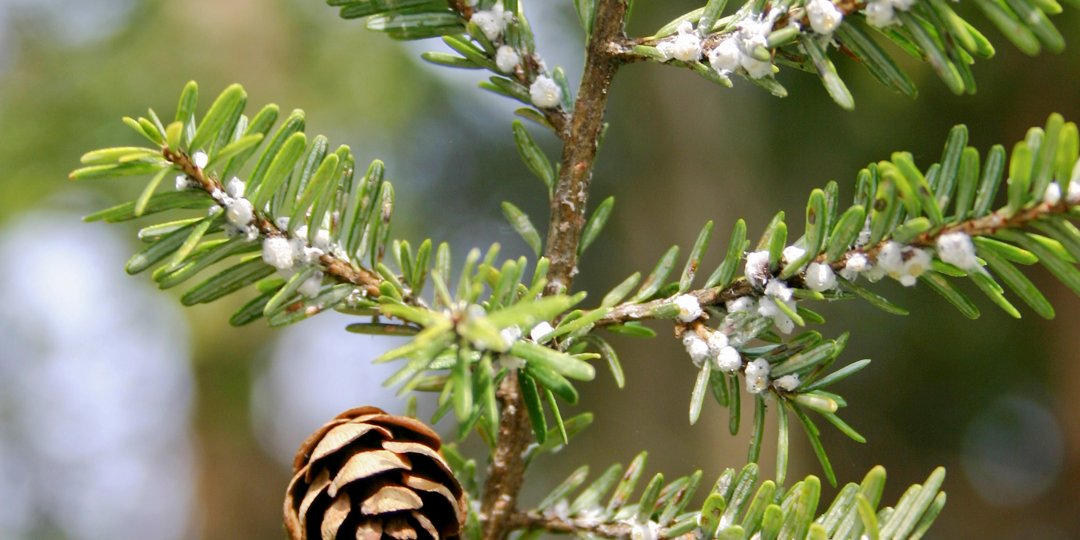
Individual HWA insects are very small and hard to see, but they are easy to identify by the numerous white, cotton ball-like masses they form at the bases of hemlock needles, often occurring on the undersides of branches.8 These tiny, but insidious pests pierce into tree needles while sucking on sap and injecting toxins, killing needles, shoots, and branches - and, if left untreated, eventually cause the death of the tree.9 HWA is most active during the cooler months of the year, from fall through winter and into early spring. During this time, the insects continually feed on plant sap from the tree’s needles, causing them to dry out and die.
Damage to infested trees is characterized by discolored needles, premature needle drop, and eventual twig and branch dieback. As adelgids feed, needles wilt, turn gray or yellow, and eventually fall off the tree, making branches bare. Hemlock woolly adelgid attacks typically start lower in the canopy and spread upwards. Without control measures, infestations spread quickly and may kill a mature tree within a few years.10
Cool Season Activity
Unlike many pests that are more active in warmer temperatures, hemlock woolly adelgid does most of its feeding in the cooler seasons of the year and goes dormant during the hot summer months.11 During these cool temperature periods, the insects feed most aggressively, killing needles that the tree needs to conduct photosynthesis to sustain it in the winter months, while depleting stored energy supplies that are necessary to produce new needles in the warmer growth season.12
This puts the tree in a double jeopardy situation where infested trees become severely stressed and fall into a downward spiral of decline – being robbed of stored nutrient reserves and unable to make new needles to replenish their energy. This compounded stress makes affected trees more prone to other pests, diseases, and environmental pressures, especially summer heat and drought.
Timing of Treatments
Especially when found early, hemlock woolly adelgid can be effectively managed with systemic treatments that move throughout the tree. The cooler temperatures and increased rainfall of the fall and early spring seasons provide an optimal treatment window, favoring conditions where treatments more easily translocate to distant branches in tall trees while targeting adelgid insects at their peak of activity when they are most active and feeding. 13
Supportive Care Is Especially Important
Along with treatments, it is important to minimize tree stress as much as possible and provide conditions that support the health needs of the tree. Hemlocks generally favor partially shaded sites with moist, organically rich soil, and they are especially stressed by prolonged periods of drought. 14 Meeting these needs as fully as possible and pairing supportive care with treatment helps ensure the effectiveness of HWA control and promote a stronger health recovery for the tree.
Some steps you can take to help your trees are keeping them adequately watered, especially during dry hot spells in the summer. Also make sure your hemlock trees are mulched properly and that the areas around them are protected from soil compaction that may be caused by repeated activities such frequent foot traffic or mowing with heavy lawn equipment.15
Avoid Fertilizers, but Care for Your Soil!
Applying fertilizers, especially formulations with high amounts of nitrogen, have been shown to aid the survival and reproduction of HWA, and should be avoided during treatment periods.16 A better solution to care for hemlock trees under HWA stress is Monster Tree Service’s Soil Health Program.
With low nitrogen inputs, our Soil Health Program complements adelgid control treatments by supporting overall hemlock health. It works by:
- Replenishing soil organic matter
- Restoring soil biology
- Rebuilding soil structure
- Supplementing soil moisture with additives that draw moisture from humidity in the air, helping your hemlocks get the hydration they need to recover from adelgid infestations
Monster Tree Service’s Integrative Care Is the Best Solution
Monster Tree Service offers comprehensive, holistic tree care tailored to the health needs of your hemlocks and all of your other trees. We look at the whole tree, from roots to crown, addressing not only pests but also the growing environment trees need to stay healthy and resilient.
By pairing specific targeted treatments with supportive care, we take an environmentally responsible approach to managing hemlock woolly adelgid, effectively controlling hemlock woolly adelgid while meeting the specific needs of hemlock trees under stress from infestation.
Before winter sets in, call us today to schedule an appointment with one of our expert arborists, who will assess your hemlock trees and develop a comprehensive treatment plan, and keep your trees beautiful and healthy for many years to come.